

The Civil War in Dorset & The Forgotten Slaves of the West Country
Puritanism, the chief challenge to the king’s authority over the Church, had a strong hold in parts of Dorset from the time of James I. One of its chief supporters was John White, vicar of Trinity Church in Dorchester, who organised expeditions of settlers to the New England colonies. Most of the port towns, with their independent—minded merchants and crafts- men, were affected; and in 1634 Archbishop Laud complained (perhaps with more annoyance than accuracy) that there were Puritans in nearly every parish in the county.
As a coastal shire, Dorset was also concerned with Ship-money from its first collection in 1634. In 1636, when it was raised from the whole country, the assessment for Dorset was £5,000. The sheriff divided this among the towns and landowners: Dorchester had to find £45, Corfe Castle and Lyme £40, Weymouth £35, Poole £30, Wareham and Blandford £25, and Bridport £20. Shaftesbury was excused that year because of plague. In 1637 the county total remained the same, but the Weymouth share was increased to £85, Poole reduced to £24, and Shaftesbury paid £5. In later years, as opposition grew and war drew nearer, the tax became very difficult to collect. In 1640 the sheriff could raise only one-twentieth of the assessment of £6,000: goods seized from those who refused to pay were taken back by force, or left uselessly in his hands because no-one would bid for them.
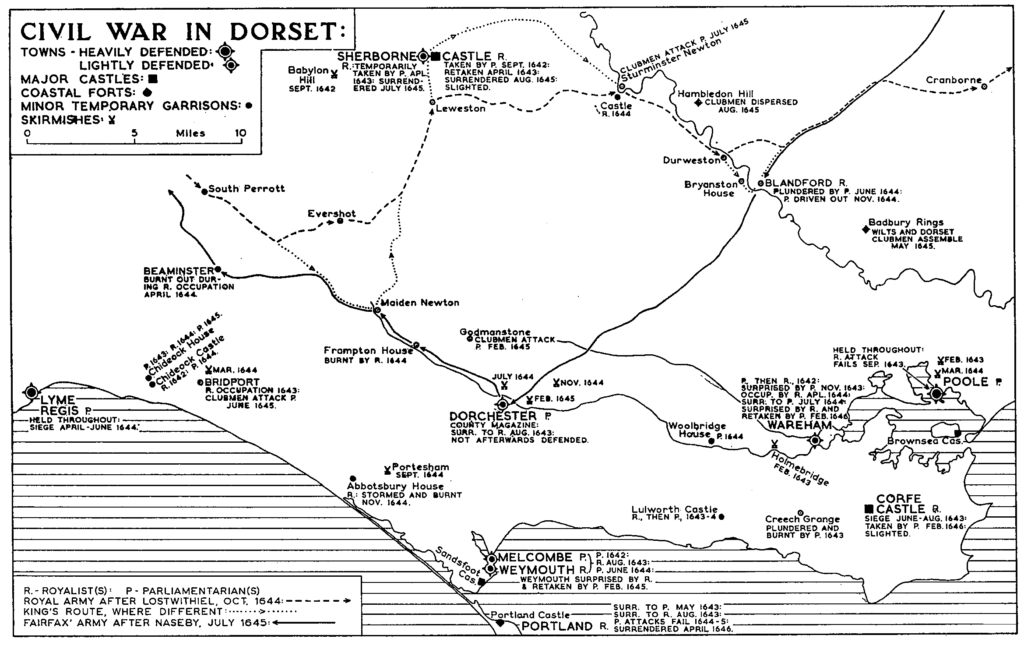
Though the larger towns were mainly Parliamentarian in sympathy, feeling in the county as a whole was very mixed when it came to a breach. Sherborne and Corfe, under the influence of their castles, were mainly Royalist, as was Blandford, and in Weymouth (as distinct from Melcombe) there were many supporters of the king. The greater land-owners, and especially those who had remained Roman Catholic, mostly sided with Charles. The Catholic Arundels of Chideock and Welds of Lulworth garrisoned their mansions, as did the (Anglican) Strangways of Abbotsbury. Ties between landlord and tenant were still strong, and most of the gentry could rely on local support.
Though no great battle occurred in Dorset, the county played an important part in the war. As it lay between the centres of Royalist strength in the South-West and at Oxford, its possession meant much to the king’s land communications. Its ports, if in his hands, were also excellently placed to draw supplies from France. Parliament was concerned to close the roads and harbours to the king, and to use the ports as garrisoned strongholds threatening the rear of any Royalist advance towards London.
When war broke out in 1642, the county town with its militia magazine of weapons and all the ports were held for Parliament. Dorchester and Poole had stone walls, and. Wareham its ancient earth ramparts, which were strengthened with earthen outworks, and Lyme and the twin borough of Weymouth and Melcombe surrounded themselves with earth— work forts and breastworks. At Dorchester, Maumbury Rings was converted into a redoubt mounting guns. Wareham soon changed hands, and the advance of the Royalist western army in 164.3 caused the surrender of Dorchester, Weymouth, and Melcombe, as well as Portland. For nearly a year the Royalists held Weymouth, but they could make no impression on Poole or Lyme. Parliament had command of the sea, and could supply and reinforce these places freely. Poole could be attacked only on one narrow front, and no serious effort was ever made against it; but Lyme should have been much harder to defend. Early in 1644 Prince Maurice laid siege to it, and in two months of hard fighting nearly battered his way in; but the garrison of 500, with the active help of the townspeople and the ships, just managed to hold their lines. During this siege Beaminster was burnt, as a result of an affray between Royalist troops quartered there.
The first large army to pass through Dorset was that of the Earl of Essex, who marched via Blandford and Dorchester injune 1644 to drive off the attackers of Lyme and to compel the surrender of Weymouth. Having done this, he passed on westwards to Exeter in hopes of capturing the Queen, but instead ran into a trap in Cornwall and left his infantry to surrender at Lostwithiel. King Charles and his troops passed through the county later in the year, on their way back from Lostwithiel to Oxford.
In 1645, when the war had already dragged on for three years and most people were heartily sick of plundering and requisitioning by both sides, the ‘Clubmen’ appeared in Dorset. These were mostly small farmers who aimed to defend their property against all comers and claimed to be neutral (though if anything their leanings were Royalist). After several isolated skirmishes with Parliamentary troops, they assembled in considerable numbers in the old hill-fort of Badbury Rings in May, and were not finally dispersed (from a similar position at Hambledon Hill) till three months later.
By this time the battle of Naseby had finally ruined the king’s cause, and the Parliamentary army led by Fairfax and Cromwell passed through Dorset on its way to crush the last Royalist forces in the West at Langport. Sherborne Castle Was taken after a valiant defence in August, and only Corfe and Portland still flew the king’s flag. Corfe Castle, which under the doughty Lady Banks had defied a previous siege, fell early in 1646 when Parliamentary troops bluffed their way in disguised as reinforcements: Portland surrendered only when further resistance was useless. The castles of Corfe and Sherborne Were deliberately wrecked or ‘slighted’ with great quantities of gunpowder, and far more damage was done than was needed simply to make them indefensible in future.

One important local effect of the war was to hasten the decline of Lyme Regis and Weymouth. These ports, whose harbours could not compare with that of Poole, had already begun to lose ground as the size of ships for ocean trading grew beyond their capacity. The war, which left Poole undamaged, caused much destruction in Lyme during the siege bombardment. Weymouth also suffered, to a lesser extent, while Royalists and Parliamentarians fought each other across the harbour in February 1645. Both places dwindled and stagnated till their nineteenth century revival as holiday resorts.
The Forgotten slaves of the West Country
Dorset’s forgotten ordeal: By Robert Hardy who explores the impact of Barbary pirate incursions on local seafaring and family histories.
In recent years, many have focused on the iniquities of the transatlantic slave trade – but it is often forgotten that for more than 300 years, Dorset, Devon and Cornwall were at the mercy of Barbary pirates from North Africa. Countries as far north as lceland were attacked, with the west coast of England a particular target. Estimates of the slaves taken from Europe between 1530 and 1780 total well over a million men, women and children.
The story is a complex one and most of these ‘pirates’ were actually privateers or corsairs, operating under the mandate of sovereign states. Their existence owed much to the rise of the Ottoman Empire, which expanded rapidly in the 16th century, threatening Europe. Privateers were affectively part of the Ottoman navy, checking all the shipping and enforcing trade agreements. Their aim was not just to capture valuable merchandise and slaves for the market in North Africa, or to ransom their captives – they also paid tax on all the assets captured. It wasn’t just North Africans – privateers included English and dutch nationals who had fallen foul of their home countries. One of the most famous was John Ward, who led a mass desertion from King James l’s navy in 1604. He is said to be the inspiration behind Johnny Depp’s Captain Jack Sparrow.
The Christian propogandists liked to convey a picture of dreadful deeds committed by Muslims, with no mention of the part that Christian Europe played, in the 16th century, the Knights of St. John in Malta were attacking Ottoman ships and selling Muslim slaves. They were effectively privateers too. ‘Perhaps they had captured Ottoman Turks who were attacking Malta at that time in great numbers and were going out to disrupt their attempts to capture Malta, any prisoners it would seem were sold off as slaves better than being put to death.’
West Country attacks
The impact of the raids on England by Barbary corsairs was noted from the 16th century – partly as a result of an ineffective naval deterrent. The situation was so terrible that an entry in the British Calendar of State Papers in May 1625 stated “The Turks are upon our coasts. They take ships only to take the men to make slaves of them.”
Barbary corsairs raided coastal villages as well as ships out at sea. In August 1625, corsairs raided Mount’s Bay in Cornwall, capturing 60 men, women and children. It was feared that there were around 60 Barbary men-o-war striking the English coast. The situation was so bad that in the same year Charles l sent a mission to North Africa to try to buy back 2,000 slaves – it was reported that there were up to 5,ooo English people in captivity in Algiers alone.
Charities were also set up to help ransom the captives and local fishing communities clubbed together to raise money to free their own.
In 1645, another raid by corsairs on the Cornish coast saw 240 men, women and children kidnapped. The following year Parliament sent Edmund Cason to Algiers to negotiate the release of English captives. He paid around £30 per man (women were more expensive) and managed to free some 250 people before he ran out of money. By the 650s the attacks were so frequent that they threatened England’s fishing industry with fishermen reluctant to leave their families unprotected ashore when they put to sea.
Dorset
Although the situation was worse in Devon and Cornwall, Dorset was hit too. In the 1620s the Mayor of Poole reported that 27 ships and 200 sailors were seized off the Dorset coast in a ten day period. There are documents in Lyne Regis Museum listing the number of mariners taken captive in the 1670s, and the large ransoms paid to free them. The Dirdoe family of Gillingham were also affected – two male members of the family were captured in 1636, but one was freed the following year thanks to the Admiralty organizing a small fleet to rescue them and others.
Oliver Cromwell declared that any captured “pirates” should be taken to Bristol and drowned, Lundy lsland, which corsairs had made their base, was attacked, but despite this they continued to raid coastal villages.
There is a vivid account of the trade in Samuel Pepy’s Diary in an entry from 1661:
“Went to the ‘Fleece Tavern’ to drink and there we spent till four o’clock, telling stories of Algiers, and the manner of the life of slaves there! And truly Captain Moortham and Mr Dawes (who had both been slaves there) did make me fully aquainted with their condition there, as how they eat nothing but bread and water. … How they are beat upon their soles of their feet and bellies at the liberty of their padron.”
The Slave’s lot
The ruling padron had the right to claim one in eight of all Christian captured. The men were mostly used to row the slave galleys, but in winter they worked on state projects, such as quarrying stone or building new galleys. They were fed on bread and water, with only one change of clothing each year. The pasha also bought most of the female captives, who were either taken into the harem or ransomed. Slaves were of any skin colour or religion, but those who converted to lslam were normally saved from rowing the galleys.
The rich were usually ransomed, while the poor would end their days dying of starvation, disease or maltreatment. Some have argued that North Africa was more of an interfaith tolerant society than Christian Europe. ‘North Africa was once Christian until Islam came and put to the sword anyone who would not convert to Islam as infidels who deserved death.’
Ending the trade
There was no formal system for ransoming slaves until, after 1640, when the Catholic clergy played the biggest role in repatriating the captives (the Protestants were more disorganized). Many countries found the best response was to pay a subsidy to the Barbary States. – ‘a form of Danegeld’ Morocco, Algiers, Tunis and Tripoli. Eventually in 1675 Sir John Narborough, with a Royal Navy squadron, managed to negotiate a peace with Tunis. A naval bombardment by the British then brought peace with Tripoli, Algiers was attacked not only by British warships but also by the French and Spanish.
The 18th century saw reduced corsair activity partly as the Ottoman Empire was on the retreat. But then the upheaval in Europe caused by the French Revolution triggered renewed attacks as the respective navies were busy fighting each other instead. After Napoleons defeat the focus shifted back to suppressing the corsairs.
Even the United States fought two wars against the Barbary States. After a formidable final attack by the British and Dutch on Algiers in 1816 more than 40,000 Christian slaves were liberated and the power of the Barbary corsairs was mostly broken. It did not end until France’s colonial occupation of Algeria in 1830.